

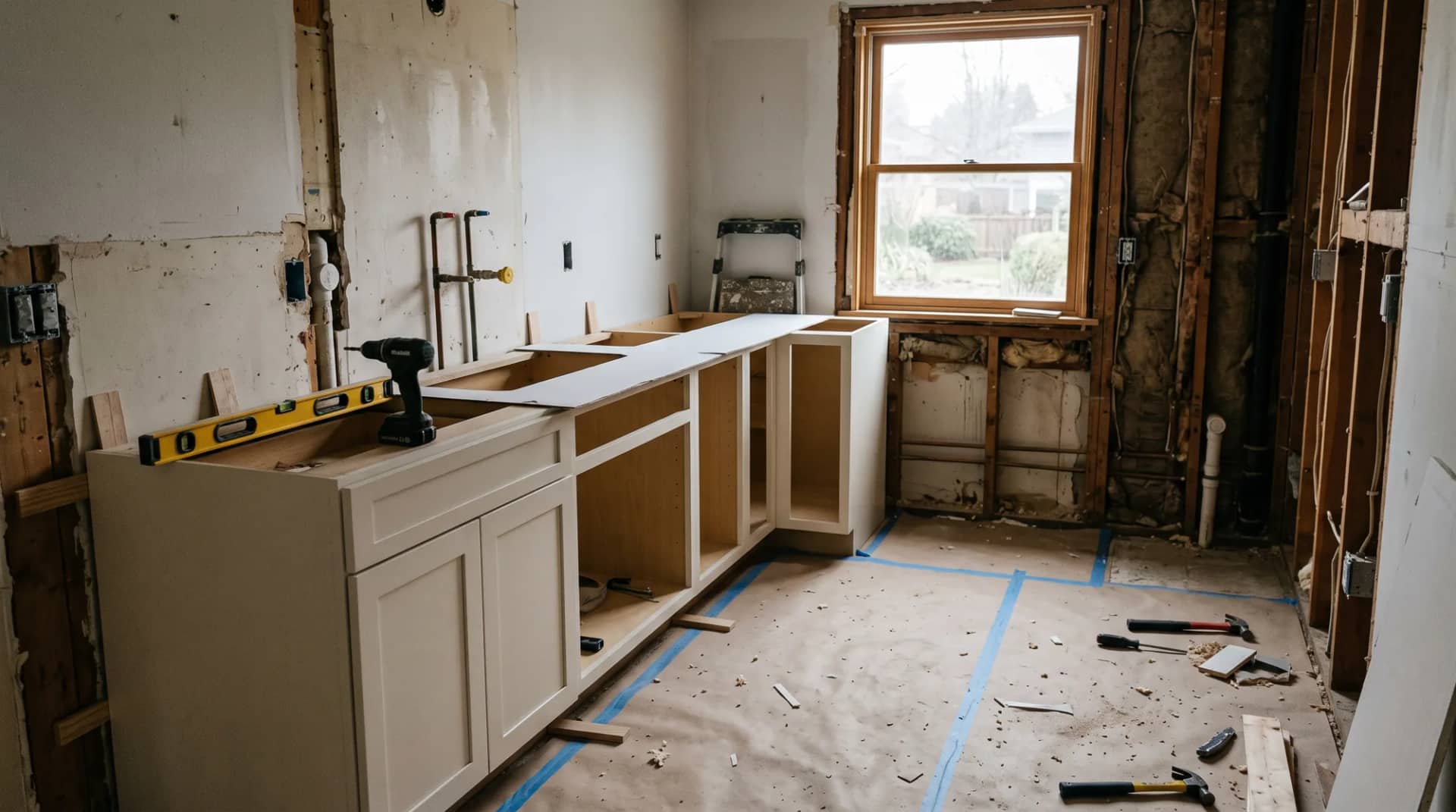
Settle the cabinets, keep the sink and range on their existing rough-ins, and get three itemized bids — that is most of what decides a Spokane kitchen budget, and it is where this guide spends its time: where the money actually goes on a real job, and how to compare three bids line by line until the cheapest one is cheap for a reason you can see. That is the part that saves you money.
The single biggest lever is cabinets. On most kitchens, the cabinetry package — boxes, doors, drawers, and installation — is the largest line item on the whole bid. That is why two remodels of the same kitchen can differ by tens of thousands: the difference between refacing the boxes you have, ordering semi-custom cabinets from a catalog, and commissioning true custom cabinetry is the difference that shows up in the bottom line first. Settle that question before you do anything else, because it sets the ceiling for everything downstream.
Everything after cabinets is a series of smaller forks: quartz or laminate on the counters, a mid-tier appliance suite or a professional-style range, whether you keep the plumbing and gas where they are or move them, and how much of the old kitchen you tear out. Each choice nudges the number, and they compound. Stack a few of them toward the high end and the project doubles without anyone doing anything wrong or dishonest.
One Spokane-specific note that surprises people: Washington sales tax lands on all of those materials, so on a materials-heavy remodel the tax line alone runs into real money. A bid that quietly leaves tax out is not cheaper — it is just less finished. Ask whether the number you are looking at includes it.
Cabinets are the biggest single line item on almost every kitchen bid — decide stock, semi-custom, or custom early, because it sets the tone for the whole budget.
A kitchen remodel is really four budgets stacked together: cabinets, countertops, appliances, and labor — with permits, disposal, and the surprises hiding behind old walls filling the gaps between them. On a typical mid-range Spokane job, cabinets and installation are the largest share, labor is the next largest, and counters and appliances split most of what is left.
Labor is a bigger slice than homeowners expect because a kitchen touches nearly every trade in the house. A single remodel can pull in a demo crew, a plumber, an electrician, a gasfitter, a cabinet installer, a countertop fabricator, a tile setter, a painter, and a flooring crew — and someone has to schedule all of them in the right order. That coordination is a real cost, and it is most of what separates a general contractor's bid from a pile of individual quotes.
The wildcard is what the demo uncovers. Spokane has a lot of housing stock built before 1950 — the Craftsman bungalows on the South Hill and in Browne's Addition, the older cottages all over the near-north side — and behind those plaster walls you find knob-and-tube wiring, ungrounded circuits, galvanized supply lines, and framing that predates any modern standard. None of it can be priced until it is exposed. On an older home, some of that upgrade work is the norm, not the exception, and a good bid leaves room for it.
That is why the number that matters here is yours, not an average. A kitchen's total is set by the cabinet grade you pick, the trades your layout forces you to call, and what forty-year-old walls are hiding — three things no published range knows about your house. Pin those three down first, then collect bids: an average that happens to land near one of your quotes tells you nothing about whether that quote is any good.
The most useful number in a kitchen remodel is the second and third itemized bid you collect on your own kitchen.
Stock, semi-custom, and custom is the biggest single fork. Stock ships in fixed sizes and finishes for the least money; semi-custom lets you tune sizes, boxes, and options from a catalog; true custom is built to your kitchen and your budget's ceiling.
Laminate is the value pick and quartz is the mid-to-upper default here — durable, low-maintenance, and forgiving of hard water. Natural stone and specialty slabs cost more in both material and fabrication. Counters are a lever you can pull independently of the cabinets.
Keeping the sink, range, and fridge where they are keeps the plumber, gasfitter, and electrician's hours down. Moving them — or taking out a wall — means new rough-in, patched floors and drywall, and often a permit. It is the fastest way to add cost.
A basic suite and a professional-style package can differ by tens of thousands. A pro range or a built-in fridge also carries hidden costs: a bigger gas line, a dedicated circuit, or a larger vent hood that has to be ducted to the exterior.
Pre-1950 Spokane homes often need knob-and-tube replaced, circuits grounded, a panel upgrade, or galvanized plumbing swapped out to meet current code — work that is invisible until demo and is not optional once it is exposed.
A cosmetic refresh that reuses the boxes and layout sits at the low end of every range. A full gut to the studs — new everything, including surprises behind the walls — sits near the top. Most remodels land somewhere in between, and where they land is a choice.
Cabinets: where most of the budget lives
If you understand one number on a kitchen bid, make it the cabinets. They are usually the largest line item, and the choice between three grades sets the ceiling for the whole project. Stock cabinets come in fixed sizes and a handful of finishes, ship fast, and cost the least — a good fit for a rental, a flip, or a tight budget. Semi-custom cabinets, ordered from a manufacturer's catalog, let you adjust sizes, door styles, boxes, and interior fittings without paying for a one-off build; this is where most Spokane mid-range kitchens land. Custom cabinets are built for your specific kitchen — any size, any finish, any oddball corner — and they cost accordingly.
Refacing is the other path, and it is genuinely worth considering. If your existing boxes are solid and the layout works, refacing keeps the cabinet carcasses and replaces the doors, drawer fronts, and visible surfaces with new veneer. It costs a fraction of new cabinetry, generates far less demolition, and it is quick. It cannot fix a bad layout or a water-damaged box, but for a kitchen that is dated rather than broken, refacing can transform the room for a small share of a full remodel's price.
When you are comparing new-cabinet quotes, look past the door style to how the box is built. Plywood boxes hold screws and resist Spokane's dry-winter, humid-summer swings better than particleboard; dovetailed, solid-wood drawer boxes on full-extension soft-close glides outlast stapled boxes on cheap slides. Framed versus frameless (European) construction changes both the look and the usable interior space. These details do not show up in a photo, but they are most of what you are paying for, and they are exactly where a suspiciously cheap cabinet package cut corners.
A typical Spokane kitchen remodel runs two to four months from the first design meeting to the final punch list, and most of that clock is spent waiting on cabinets. Order them early — the lead time, not the demolition, is usually the longest part of the project. Because the work is interior, it runs year-round, but book ahead: good crews and fabricators are scheduled weeks out.
How to read a Spokane kitchen bid
The trap in kitchen bids is the allowance. Because you often pick the exact cabinets, counters, and appliances after signing, contractors carry a dollar figure — an allowance — as a placeholder for each. A bid can look cheap simply because its cabinet allowance is set below what you will actually spend, and the difference comes back as a change order later. Compare the allowances line by line, not just the totals, and ask what a realistic number looks like for the finishes you actually want.
Then read how the work itself is spelled out. A real bid names the cabinet brand and line and describes the box construction — plywood or particleboard, framed or frameless, drawer glides and hinges. It states the countertop material and edge, the appliances or their allowances, who supplies and installs each, and how flooring, drywall, paint, and the range hood duct are handled. If a quote is one round number with no breakdown, you cannot tell what was assumed or left out — and in a kitchen, what is left out is what becomes a change order.
Confirm who is actually coordinating the trades and that everyone touching the job is licensed. Washington requires general contractors to register with Labor & Industries, carry a bond, and hold liability insurance, and it requires the electrical and plumbing work to be done under the proper specialty certifications — you can verify any contractor's registration and standing yourself at secure.lni.wa.gov before you sign. Ask who pulls the permits, whether the plumber and electrician are in-house or subs, and — if you are moving a gas line for a range — that a licensed gasfitter does the work and Avista's inspection requirements are met.
Finally, pin down change orders in writing before demo starts. On Spokane's older homes especially, the walls will hold at least one surprise — old wiring, a rotted subfloor, a supply line that has to be replaced. A fair contract says how change orders are priced and approved so that an unexpected find is a documented cost, not a renegotiation mid-project. When you are ready to gather quotes, pull three names from our Spokane remodeling directory — licensed local contractors, each carrying a dated licence check and a link to the state record — and hand all three the same itemized questions.
Start here: licensed Spokane remodeling pros with a verified registration. Hand them the same scope and get three written, itemized bids back.
Allpro Renovation & Remodeling LLC
Remodeling
Berry Built & Design Inc.
Remodeling
B-Line Construction & Remodeling Inc.
Remodeling
The questions homeowners ask us most
How much does a kitchen remodel cost in Spokane?
Three things decide your total, and you can settle all three before you sign anything: the cabinet grade you choose (stock, semi-custom, or custom — the largest line item on nearly every kitchen bid), whether the sink, range, and fridge stay on their existing plumbing, gas, and wiring, and what demo uncovers behind the walls of an older Spokane home. The number worth having is your own: three written, itemized bids on your actual kitchen, compared allowance by allowance.
Why are cabinets the most expensive part of a kitchen remodel?
On most kitchens the cabinetry package — boxes, doors, drawers, and installation — is the single largest line item on the bid. That is because it spans the biggest range of choices: stock cabinets in fixed sizes cost the least, semi-custom from a catalog costs more, and true custom built for your kitchen costs the most. The grade you pick effectively sets the ceiling for the whole project's budget, which is why it is the first decision to make and the first line to compare across bids.
Is it cheaper to reface cabinets or replace them?
Refacing is considerably cheaper, because it keeps your existing cabinet boxes and replaces only the doors, drawer fronts, and visible surfaces rather than tearing the carcasses out and starting over. It is a strong option when the boxes are solid and the layout already works, and it generates far less demolition. It cannot fix a bad layout or a water-damaged box, so if you need to move things or the cabinets are failing, new cabinetry is the better spend. The gap between the two depends entirely on your kitchen, so price both on your own: ask for a reface quote and a new-cabinet quote on the same layout, and compare them side by side.
How much does it cost to move the sink, range, or gas line?
It varies more than almost anything else in the job, so make it its own line on every bid rather than part of a lump sum. The shape of it: moving the sink means new water and drain lines, and moving a gas range means a licensed gasfitter reworks the line and it gets inspected — either can trigger a permit, and in an older Spokane home either can uncover pipe or wiring that has to be replaced once it is exposed. Keeping the major fixtures on their existing rough-ins is one of the most effective ways to hold a kitchen budget down, which is exactly why contractors ask about it first.
Do I need a permit to remodel my kitchen in Spokane?
A cosmetic refresh — new cabinets, counters, paint, and appliances in the same spots — usually does not require a building permit, but any electrical, plumbing, or gas work does, as do structural changes like removing a wall. The City of Spokane calculates residential permit fees from project valuation rather than charging a flat rate, so use the city's fee calculators or ask your contractor to show the permit as a line in the bid. Your contractor normally pulls them; confirm who is responsible in the contract, and verify the contractor's registration at secure.lni.wa.gov before you sign.
Why do older Spokane homes cost more to remodel?
Much of Spokane's housing stock predates 1950, and behind the plaster you often find knob-and-tube wiring, ungrounded circuits, galvanized plumbing, and non-standard framing. None of it can be priced until demo exposes it, and once it is exposed, bringing it up to current code is generally required rather than optional. Budget a contingency for these finds, and make sure your bid spells out how change orders are priced.
How long does a kitchen remodel take in Spokane?
Plan on two to four months from the first design meeting to the final punch list, sometimes longer for custom work. Most of that time is spent waiting on cabinets — lead times of 6 to 16 weeks are common — not on the on-site construction, which is usually a few weeks. Because the work is interior it runs year-round, but good crews and countertop fabricators book weeks out, so order cabinets early.