

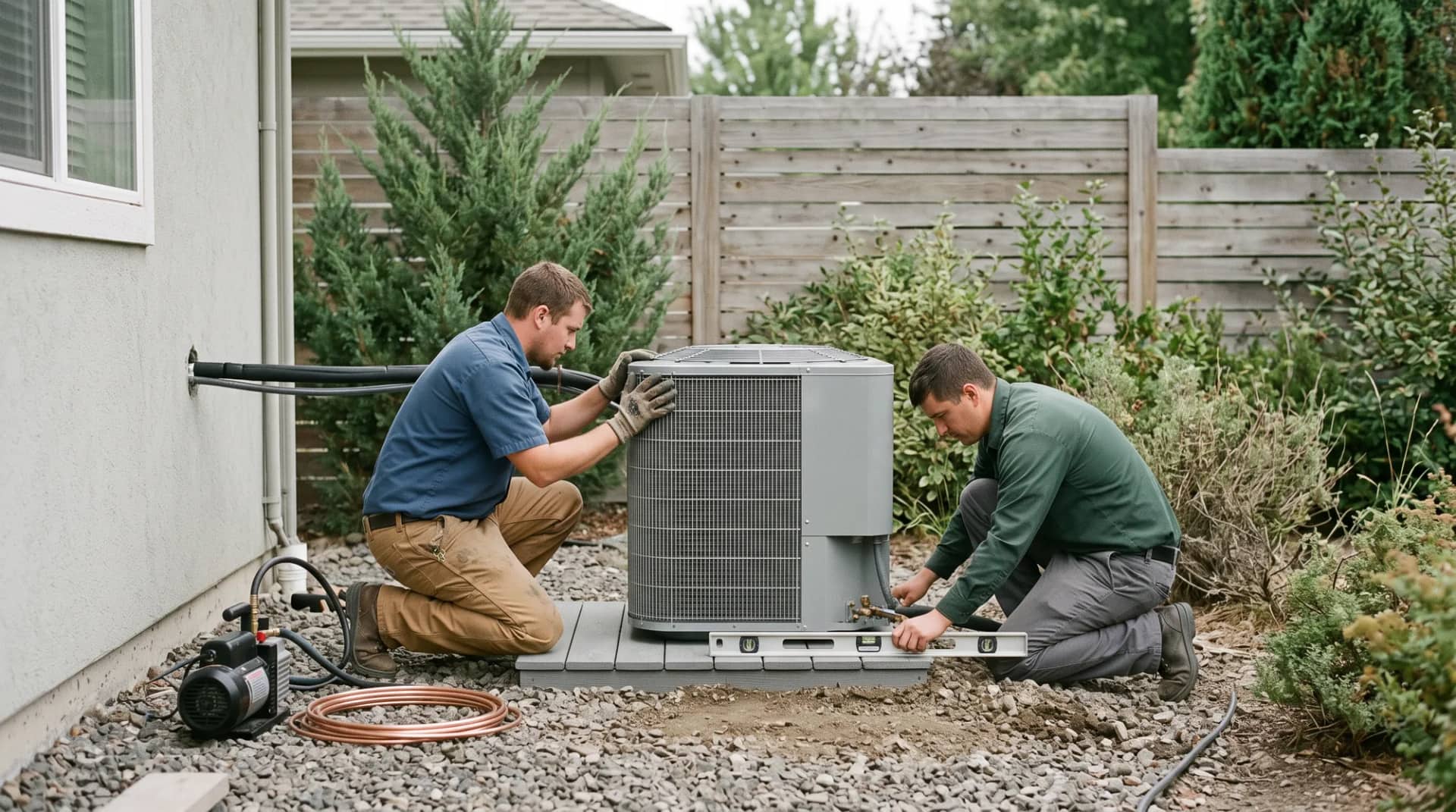
hvacprojectcost.com puts a full Spokane system replacement at $6,000 to $10,500, and prices the main system types statewide: a ducted heat pump at $6,000 to $13,500, a furnace-and-AC pairing at $8,000 to $15,500, and a ductless mini-split at $4,000 to $8,500. Those figures were checked on 12 July 2026 and are laid out with their sources in the table below. The things that push a real bid toward the top of any of these ranges never appear on a spec sheet: undersized ductwork, a full electrical panel, a cramped mechanical room, and our winter design temperature.
Spokane sits in a heating-dominated climate, and the equipment you buy has to earn its keep for the better part of the year. Our winter design temperature is in the single digits, Arctic outbreaks drop us below zero for days at a time, and the heating season stretches from October well into April. Then summer flips the script — dry, often smoky, and regularly into the 90s and low 100s — so cooling is no longer the luxury it was for earlier generations of Spokane homeowners. A system here is sized for a genuinely cold winter and a genuinely hot summer, a wider swing than a mild coastal market asks for, and that shows up in both the equipment and the labor.
The big shift over the last decade is that cold-climate heat pumps finally make sense in the Inland Northwest. Older heat pumps gave up on the coldest nights and handed off to expensive electric backup, which is why they never caught on here. Today's variable-speed, inverter-driven cold-climate units hold most of their heating capacity down into the single digits and keep producing heat well below zero, so a properly sized one can carry a Spokane winter with far less reliance on backup. Whether it pencils out against cheap Avista natural gas depends on your house, your panel, and the rebates you qualify for — which is exactly why the bids vary so much.
The practical takeaway: with HVAC you are buying a system that was sized for your specific house, not a box off a shelf. Two bids can both say “heat pump,” or both say “96% furnace,” and differ by thousands — and the gap is almost always in the parts you can't see on the spec sheet: whether the contractor ran a real load calculation, what shape your ductwork is in, whether your electrical panel can feed a heat pump, and which efficiency tier they quoted.
A right-sized system beats an oversized one every time — insist on a load calculation, not a rule-of-thumb swap of whatever was there before.
A Spokane HVAC install breaks down into four buckets: the equipment itself (the furnace, heat pump, or air handler, plus the coil, thermostat, and controls), the labor to remove the old system and install the new one, the ductwork that distributes the air, and the electrical or gas work that feeds it. On a like-for-like furnace swap the equipment and labor dominate and the rest is minor. On a heat pump — especially in an older home — the ductwork and electrical can quietly become the biggest line items on the page.
Ductwork is the wildcard, and it matters more with a heat pump than a furnace. A gas furnace pushes hot air and tolerates leaky, undersized ducts; a heat pump moves a larger volume of cooler air and needs the ducts to actually carry it, or it never delivers the comfort or the efficiency you paid for. Many older Spokane homes — additions, oil-to-gas conversions, and houses where the ducts were sized decades ago — have runs that leak into the crawlspace or are simply too small for a modern system. A good contractor tests and, where needed, seals or resizes them; a cheap bid ignores the ducts and blames the equipment later.
Electrical is the other surprise, and it shows up only on heat pump and AC projects. A heat pump needs a dedicated circuit, and if it carries electric-resistance backup heat it can pull enough current that an older 100-amp panel simply can't feed it. Plenty of Spokane homes built before the 1990s — and nearly anything still on its original service — need a panel or service upgrade before a heat pump can go in. That work is real money, it requires a licensed electrician and a separate electrical permit, and an honest bid names it up front instead of discovering it on install day.
Note what the Seattle comparison shows: the same source prices a Spokane job below a Seattle one, which is the east-of-the-Cascades discount doing real work. Three costs sit outside the ranges above — adding AC to an existing furnace, ductwork repair, and the electrical panel upgrade a heat pump often needs. Ask for each as its own line on the bid: they are where two quotes on the same house diverge.
- hvacprojectcost.comread 2026-07-12
A Washington-focused cost guide, with a Spokane-specific replacement range and a statewide breakdown by system type.
- homeyouread 2026-07-12
A lead-generation site whose Spokane figures come from a national model rather than local quotes — which is why they run low against every other source here.
A like-for-like furnace replacement is the least expensive path. Adding air conditioning, moving to a heat pump, or going ductless each adds equipment and labor. A whole-home cold-climate heat pump with electrical work sits at the top of the range; a straight furnace swap sits at the bottom.
The most important number in the bid is the one you never see on a spec sheet — the Manual J load calculation that sizes the system to your house. Bigger is not better: an oversized furnace short-cycles and an oversized heat pump loses efficiency and comfort. A contractor who sizes by “what was here before” is guessing.
Leaky, undersized, or poorly designed ducts cap what any system can deliver. Sealing, resizing, or replacing runs — especially for the higher airflow a heat pump needs — can add materially to the job, and it's the difference between a system that performs and one that disappoints.
Heat pumps and electric backup heat draw real current. An older 100-amp panel or an original service often needs an upgrade before a heat pump can be fed safely, which means a licensed electrician and a separate permit. Gas furnaces rarely trigger this.
Furnaces are rated by AFUE — how much fuel becomes heat — while heat pumps and AC use HSPF2 and SEER2 under the newer M1 test standard. Higher tiers cost more up front, cut operating cost, and are usually the threshold to qualify for rebates, so the efficiency you choose changes both the price and the incentive.
Incentives can meaningfully offset a heat pump, but only if the equipment qualifies — and the programs change. Federal energy-efficiency tax credits have been revised repeatedly in recent budget cycles, Avista offers rebates on qualifying equipment, and Washington runs state-administered heat-pump programs — all with efficiency thresholds and AHRI-match requirements. Confirm what's actually available the month you buy, not what applied last year.
Furnace, heat pump, or both?
For most of the last generation, the default Spokane answer was a high-efficiency gas furnace, and cheap Avista natural gas made that easy. That has genuinely changed. A modern cold-climate heat pump — variable-speed, inverter-driven, and rated for low-temperature operation — will heat a well-insulated Spokane house through most of our winter on electricity alone, and it gives you air conditioning in the same box for our increasingly hot, smoky summers. For a lot of homeowners it is now the system that does the most with a single install.
The hedge that fits our climate especially well is a dual-fuel system: a heat pump paired with a gas furnace. The heat pump does the efficient work down to a set outdoor temperature, then hands off to the furnace on the coldest nights when gas is both cheaper and more powerful. You get heat-pump efficiency and cooling most of the year, plus the brute-force reliability of gas in a cold snap — at the cost of buying and installing two pieces of equipment instead of one.
A straight gas furnace still wins in specific cases. If your existing ductwork and electrical can't support a heat pump without expensive upgrades, if your furnace just died in January and you need heat now, or if your rates and usage make gas clearly cheaper to run, a high-efficiency furnace — often paired with a separate AC — is the pragmatic choice. There is no universally correct answer; the right one depends on your home's ducts and panel, how long you plan to stay, and which rebates you can actually claim. A good contractor prices more than one path and shows you the trade-offs rather than selling you a single box.
A straightforward furnace swap is often a one-day job once the crew arrives; a whole-home heat pump with ductwork or electrical work runs two to three days. The longer part is everything before the install — getting and comparing bids, confirming rebate eligibility, and pulling the mechanical (and sometimes electrical) permit. Emergency winter replacements move fast but cost more; planned upgrades are cheapest in the spring and fall shoulder seasons.
How to read a Spokane HVAC bid
A real HVAC bid is specific. It names the exact equipment — make, model, and efficiency rating (AFUE for a furnace; HSPF2 and SEER2 for a heat pump or AC) — and it references a Manual J load calculation done for your house, not a size copied off the old unit. For a heat pump or AC, the indoor coil and outdoor unit have to be a matched, AHRI-certified pair; the AHRI certificate number is what proves the rated efficiency and what most rebates require. If a quote is a single number with a brand name and no load calc, no model numbers, and no efficiency ratings, you can't tell what you are actually buying.
Confirm who pulls the permits and does the work. Washington requires HVAC contractors to register with Labor & Industries (L&I), carry a contractor bond, and hold liability insurance, and you can verify any contractor's status yourself at secure.lni.wa.gov before you sign. Mechanical and gas work needs a permit and inspection in Spokane, and any panel or service upgrade needs a separate electrical permit and a licensed electrician. A reputable contractor pulls the permits in their own name — if they ask you to pull an owner permit for professional work, treat that as a flag.
Read the warranty in two parts: the manufacturer's warranty on the equipment (often 10 years on parts if you register it, sometimes longer on a heat-pump compressor) and the contractor's labor warranty on the installation. The install is what fails first when it's done wrong, so a written labor warranty matters as much as the badge on the box. Collect at least two or three itemized bids and compare where they diverge — the load calc, the ductwork and electrical scope, the efficiency tier, and the warranty — not just the bottom line. Line up your bidders from our Spokane HVAC directory — licensed local contractors, each with a dated licence check and a link to the state record. Ask every one of them for a load calc and matched model numbers, and the bids become genuinely comparable.
Start here: licensed Spokane HVAC pros with a verified registration. Hand them the same scope and get three written, itemized bids back.
The questions homeowners ask us most
What does a new furnace or heat pump cost in Spokane?
hvacprojectcost.com puts a full Spokane system replacement at $6,000–$10,500, and prices system types statewide at $6,000–$13,500 for a ducted heat pump, $8,000–$15,500 for a furnace-and-AC pairing, and $4,000–$8,500 for a ductless mini-split, with a Spokane mechanical permit at $75–$300. Those figures were checked on 12 July 2026 and are linked on this page. Ductwork condition, electrical panel capacity, system size, and efficiency tier are what separate two bids on the same house, so read the itemized quote for those four lines before you compare bottom lines.
Do heat pumps actually work in Spokane's cold winters?
Yes — modern cold-climate heat pumps are a real change from the units of a decade ago. Variable-speed, inverter-driven models hold most of their heating capacity into the single digits and keep producing heat below zero, so a properly sized one can carry most of a Spokane winter on electricity alone. On the very coldest nights many homeowners pair one with gas backup (a dual-fuel system) or electric-resistance backup. The key is correct sizing from a load calculation — an undersized or oversized heat pump is where cold-climate performance goes wrong.
Is a heat pump or a gas furnace cheaper to run here?
It depends on your rates, your house, and the weather. Avista natural gas has historically been inexpensive in Spokane, which is why gas furnaces have long been the default. A high-efficiency cold-climate heat pump can still come out ahead over a full year because it also provides cooling and runs efficiently through our long shoulder seasons, and rebates can tilt the up-front math. A dual-fuel system splits the difference — heat pump most of the year, gas on the coldest nights. Ask your contractor to model both for your specific home.
What is a Manual J load calculation and why does it matter?
Manual J is the industry-standard method for calculating exactly how much heating and cooling your house needs, based on its size, insulation, windows, and our local design temperatures. It is the number that should size your system. Bigger is not better: an oversized furnace short-cycles and wears out sooner, and an oversized heat pump loses efficiency and comfort. A contractor who sizes by “whatever was here before” or a square-footage rule of thumb is guessing — insist on a load calc.
Will I need an electrical panel upgrade for a heat pump?
Possibly. Heat pumps need a dedicated circuit, and if the system carries electric-resistance backup heat it can draw enough current that an older 100-amp panel can't feed it safely. Many Spokane homes built before the 1990s, or any home still on its original service, need a panel or service upgrade first. That work requires a licensed electrician and a separate electrical permit, so a good bid identifies it up front rather than surprising you on install day. Gas furnaces rarely trigger this.
What rebates or tax credits are available for a new system?
It depends on the programs in effect when you buy — and they change often, so confirm current details rather than relying on last year's rules. Federal energy-efficiency tax credits have been revised repeatedly in recent budget cycles, Avista offers rebates on qualifying equipment, and Washington runs state-administered heat-pump incentive programs. Almost all of them require the equipment to hit specific efficiency thresholds and, for heat pumps and AC, to be an AHRI-matched system — so eligibility hinges on which model your contractor quotes. Verify what you qualify for before the install, not after.
When is the best time to replace my HVAC system in Spokane?
The spring and fall shoulder seasons are cheapest and least rushed — contractors aren't slammed with emergency no-heat and no-cool calls, and you have time to compare bids and confirm rebates. Replacing during a January cold snap or a July heat wave means paying an emergency premium and choosing from whatever's in stock. If you're planning ahead, a summer heat wave that exposes an aging system is a good prompt to line up a replacement for the fall.